Houston's AI Revolution: What Small Businesses Need to Know
Key Takeaways
- Houston has 100,000+ small businesses, making it the most business-dense major city in Texas.
- Energy sector volatility makes AI-powered financial forecasting and demand planning critical for Houston SMBs.
- Houston is the most ethnically diverse large city in America, and AI-powered multilingual engagement is a competitive advantage.
- Hurricane season and extreme weather create unique supply chain challenges that AI helps predict and mitigate.
- The Texas Medical Center ecosystem creates massive opportunities for AI in healthcare-adjacent small businesses.
Houston's small business community is undergoing a quiet AI revolution. In America's fourth-largest city (home to the energy capital of the world, the largest medical center on the planet, and one of the most diverse populations in the country), artificial intelligence is helping over 100,000 small businesses navigate volatile markets, serve multilingual customers, and compete against industry giants.
This isn't Houston's first transformation. The city that reinvented itself from an oil town to a diversified economic powerhouse is now reinventing how its small businesses operate. Here's what every Houston business owner needs to know about AI in 2026.
Houston's Unique Business Environment
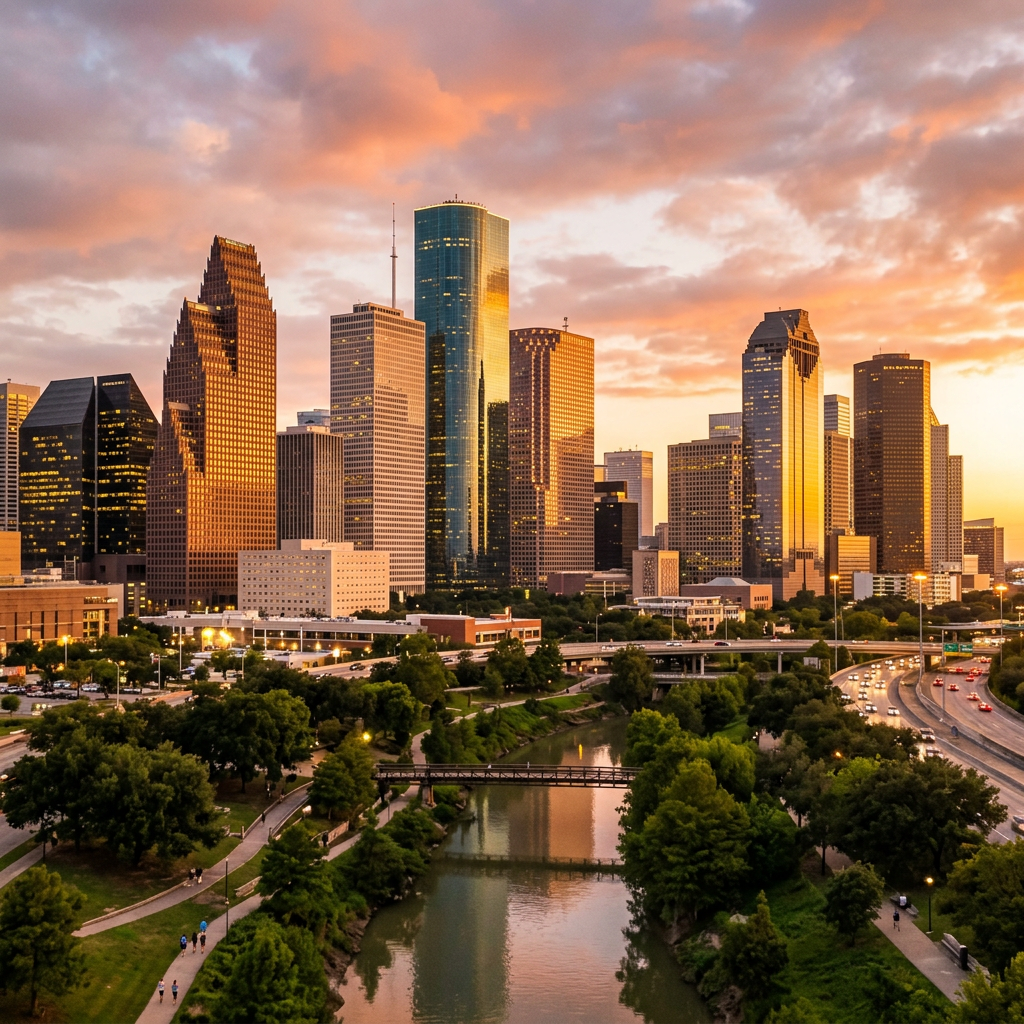
Houston's economy is unlike any other major U.S. city. The energy sector (oil, gas, renewables, and petrochemicals) still anchors the regional economy, but Houston has diversified dramatically. The Texas Medical Center employs over 106,000 people. The Port of Houston is the largest port in the U.S. by foreign waterborne tonnage. NASA's Johnson Space Center drives an aerospace ecosystem. And the city's 2.3 million residents represent one of the most ethnically diverse populations in the country, with large Hispanic, Asian, African American, and immigrant communities.
For small businesses, this means operating in an environment characterized by:
- Economic volatility tied to global energy prices
- Extreme weather events including hurricanes, flooding, and heat waves
- Multilingual customer bases requiring communication in English, Spanish, Vietnamese, Mandarin, and Hindi
- Intense competition across sectors from food service to professional services to construction
According to the Greater Houston Partnership's 2025 economic report, Houston-area small businesses employing 1-50 people generate over $120 billion in annual revenue. AI is increasingly how these businesses protect and grow that revenue.
How Houston SMBs Are Deploying AI
Energy Sector Supply Chain Optimization
Even businesses not directly in the energy industry feel the ripple effects of oil price swings. Restaurants in the Energy Corridor see lunch traffic drop when upstream companies cut contractors. Equipment suppliers in Pasadena experience demand spikes and crashes that follow rig counts. Real estate agents in Katy and Sugar Land watch housing demand shift with energy employment.
AI-powered demand forecasting helps these businesses anticipate shifts before they hit the bottom line. A catering company serving corporate clients in the Galleria area uses AI to correlate its booking patterns with energy sector indicators: WTI crude prices, rig counts, and corporate earnings announcements. When the model predicts a downturn in corporate event spending, the company shifts marketing toward private events and weddings. This proactive approach helped them maintain revenue within 8% during a period when competitors saw 25-35% declines.
Multilingual Customer Engagement
Houston's diversity is a business asset, but only if businesses can communicate effectively with their customer base. The Houston metropolitan area is approximately 45% Hispanic, 7% Asian, and 18% Black, according to U.S. Census data. In neighborhoods like Bellaire (Little Saigon), Hillcroft (Mahatma Gandhi District), and Gulfton, business is conducted in multiple languages daily.
AI-powered customer service tools enable small businesses to engage customers in their preferred language without hiring multilingual staff for every shift. A dental practice near the Gulfton area implemented an AI scheduling and communication system that operates in English, Spanish, and Vietnamese. New patient bookings increased 55% in six months because prospective patients could ask questions and schedule appointments in their native language at any hour.
Hurricane Season and Weather-Related Demand Planning
Houston's vulnerability to hurricanes, tropical storms, and flooding events creates unique planning challenges for small businesses. Hurricane Harvey in 2017 caused $125 billion in damage. Since then, multiple storms have disrupted supply chains, forced temporary closures, and created unpredictable demand surges for everything from construction materials to generator repairs.
AI helps in two ways: predictive planning and rapid response. Businesses use AI models trained on historical storm data, NOAA forecasts, and local impact patterns to pre-position inventory, adjust staffing, and activate emergency communication plans before storms hit. A building materials supplier in northwest Houston credits AI-driven inventory positioning with capturing $400,000 in post-storm sales that they would have missed with traditional ordering patterns.
Healthcare-Adjacent Services
The Texas Medical Center — the world's largest medical complex — creates a gravitational pull for thousands of small businesses: medical device suppliers, staffing agencies, billing services, home health providers, diagnostic labs, physical therapy clinics, and more. AI is transforming how these businesses operate.
Medical billing companies in the TMC area are using AI to automate claim submission, denial management, and payment posting , reducing processing time by 60% and denial rates by 35%. Home health agencies are using AI for patient scheduling optimization, reducing drive time between visits by 25% and enabling each nurse to see 2-3 additional patients per week. Clinical staffing agencies use AI to match available healthcare workers with facility needs based on credentials, experience, location, and historical performance data.
The Economics of AI for Houston Businesses
Houston's business environment offers a particularly compelling financial case for AI adoption:
- - **Office rents**
- While lower than NYC or SF, Houston commercial rents have increased 15% since 2022, making efficiency gains more valuable.
- - **Labor market tightness**
- Houston's unemployment rate has hovered near 4% through 2025, making it harder and more expensive to hire. AI fills the gap.
- - **Energy cost volatility**
- Businesses on variable-rate electricity contracts can use AI to optimize energy consumption during peak pricing periods, saving 15-30% on utility bills.
A professional services firm in the Woodlands with 25 employees implemented AI across three functions (client onboarding, document processing, and appointment scheduling) at a total cost of $18,000 for the first year. The resulting efficiency gains were valued at $95,000 annually: equivalent to saving 2.5 full-time positions at Houston labor rates.
Industry-Specific AI Applications in Houston
Oil & Gas Services
Small businesses supporting the energy industry (equipment rental, inspection services, environmental consulting, logistics) use AI for predictive maintenance scheduling, compliance document management, safety incident analysis, and demand forecasting tied to drilling activity indicators.
Construction and Trades
Houston's perpetual construction boom (the city issued over $20 billion in building permits in 2025) means opportunity for contractors, but also fierce competition and tight margins. AI helps with project estimation, material cost forecasting, workforce scheduling, and subcontractor management.
Food and Hospitality
Houston's food scene is internationally recognized. The city's 12,000+ restaurants use AI for everything from inventory management (critical in Houston's heat, where spoilage rates run 15-20% higher than northern cities) to delivery route optimization and personalized marketing campaigns targeting the city's incredibly diverse palate.
International Trade and Logistics
Businesses connected to the Port of Houston — customs brokers, freight forwarders, warehousing companies — are using AI to optimize container scheduling, predict clearance delays, and manage the complex documentation required for international trade. A customs brokerage in the Ship Channel area reduced average clearance time by 40% after implementing AI document processing.
Getting Started: A Houston Business Owner's Guide
Step 1: Assess your weather and market vulnerability. Houston businesses face unique risks from weather events and energy market swings. AI tools that help you predict and prepare for these disruptions often deliver the fastest ROI.
Step 2: Evaluate your multilingual opportunity. If your customer base includes non-English speakers (and in Houston, it almost certainly does), multilingual AI engagement tools can unlock significant revenue from underserved segments.
Step 3: Connect with the Houston ecosystem. The Houston Technology Center, SCORE Houston, and the SBA Houston District Office all offer resources for technology adoption. Rice University's Liu Idea Lab for Innovation frequently hosts AI workshops for local businesses.
Step 4: Start with one high-impact use case. Whether it's automating customer inquiries, optimizing inventory, or improving marketing targeting, pick the pain point that costs you the most and address it first.
The Future of AI in Houston's Business Community
Houston has always been a city of reinvention. From cotton to oil to space to medicine to technology, the city transforms itself by embracing what comes next while building on what came before. AI is the latest chapter in that story.
The small businesses that thrive in Houston's next decade will be those that combine the city's legendary hustle with AI's ability to process information, automate routine work, and unlock insights from data. The tools are accessible. The ROI is proven. The only variable is how quickly you start.
Frequently Asked Questions
What makes Houston's AI opportunity unique for small businesses?
Houston's unique combination of energy sector volatility, extreme weather events, a multilingual population (45%+ Hispanic), and the Texas Medical Center ecosystem creates AI use cases that don't exist in other cities. Energy-correlated demand forecasting, bilingual customer engagement, and hurricane preparedness AI are distinctly Houston applications.
How does AI help Houston businesses prepare for hurricane season?
AI helps Houston businesses with predictive planning and rapid response. Models trained on historical storm data, NOAA forecasts, and local impact patterns help businesses pre-position inventory, adjust staffing, and activate emergency communication plans before storms hit. Some businesses credit AI with capturing hundreds of thousands in post-storm sales they would have missed.
Is AI affordable for small businesses in Houston?
Yes. Houston's lower cost of living compared to coastal cities means AI tools (typically $200-$1,000/month) are even more accessible. A professional services firm with 25 employees can implement AI across three functions for approximately $18,000/year while generating $95,000+ in annual efficiency savings.