Chicago Small Businesses Turn to AI to Stay Competitive
Key Takeaways
- Chicago has 300,000+ small businesses navigating seasonal extremes, supply chain complexity, and a competitive B2B market.
- The city's manufacturing heritage means AI-powered operational efficiency resonates deeply, and businesses think in terms of process improvement.
- Chicago's brutal seasonality (winter temps dropping to -20°F) makes AI demand forecasting essential for businesses with weather-dependent revenue.
- O'Hare and Midway airports, combined with the nation's largest rail hub, make Chicago an AI supply chain optimization hotbed.
- Chicago's food industry, from Michelin-starred restaurants to neighborhood delis, is among the most AI-progressive in the country.
Chicago's small business community has always been defined by resilience. A city that rebuilt itself after the Great Fire, reinvented itself through industrialization, and weathered economic cycles tied to manufacturing, finance, and trade doesn't adopt new technology out of curiosity. It adopts because the technology works.
In 2026, AI is working for Chicago's 300,000+ small businesses. Not as a Silicon Valley curiosity, but as a practical tool for managing the operational challenges that make Chicago uniquely demanding: extreme seasonal swings, complex supply chains, a competitive B2B landscape, and operating costs that keep climbing.
Chicago's Business Environment
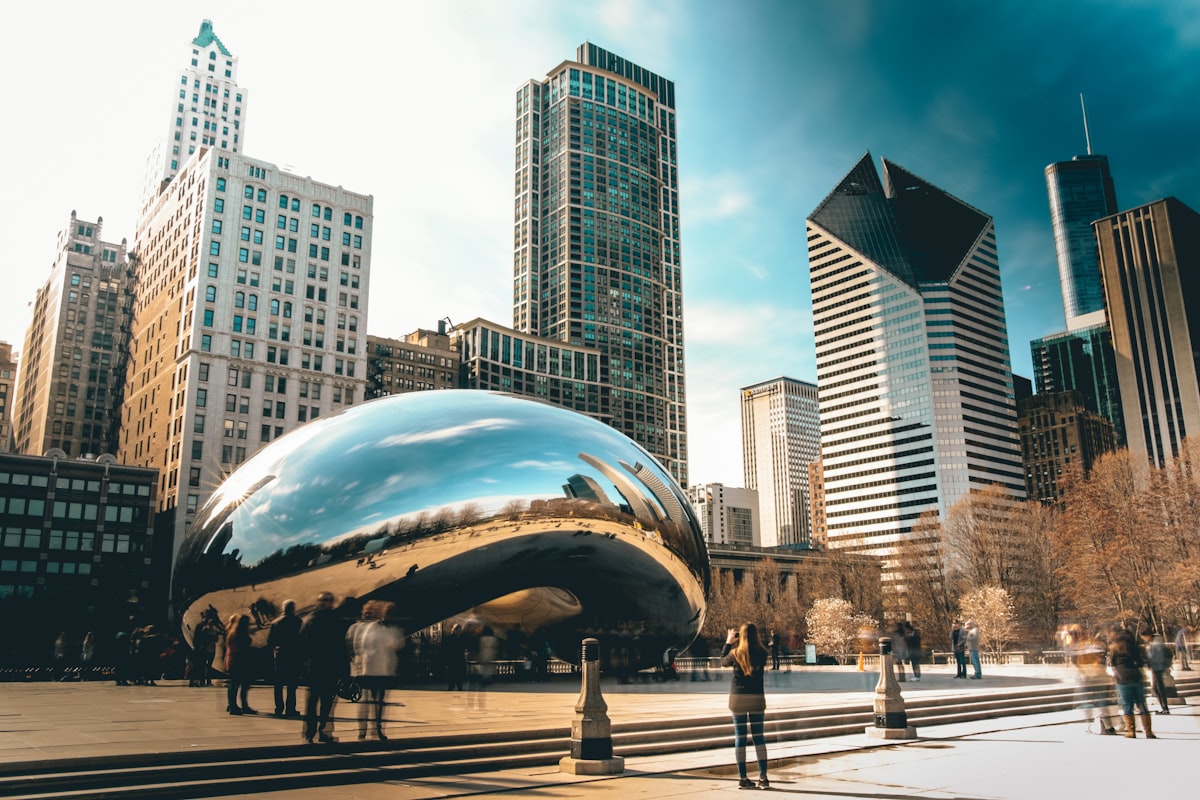
Chicago is America's third-largest city and the economic engine of the Midwest. Its GDP exceeds $700 billion, driven by a diversified economy spanning manufacturing, logistics, financial services, food processing, healthcare, and professional services. The city sits at the intersection of the nation's freight rail, highway, and air networks. O'Hare International Airport is one of the world's busiest, and Chicago handles more rail freight than any other city in North America.
For small businesses, Chicago offers enormous market access but demanding operating conditions:
- - **Extreme seasonality**
- Temperatures range from -20°F in January to 95°F+ in July, with each season fundamentally changing consumer behavior, foot traffic, and demand patterns
- - **Complex logistics**
- The city's role as a transportation hub creates supply chain opportunities but also congestion, delivery unpredictability, and warehousing costs
- - **Competitive labor market**
- Unemployment has remained below 5% since 2022, making hiring and retention increasingly challenging
- - **Neighborhood-driven markets**
- Chicago's 77 community areas each have distinct demographics, preferences, and economic conditions
AI helps small businesses navigate all of these complexities more effectively than manual processes ever could.
How Chicago Small Businesses Are Deploying AI
Manufacturing and Industrial Services
Chicago's manufacturing heritage runs deep. While large factories have consolidated, thousands of small manufacturers, machine shops, fabricators, and industrial service companies operate throughout the city and suburbs, from Elk Grove Village (the largest contiguous industrial park in the U.S.) to the South Side's industrial corridors.
AI helps these businesses with:
- - **Predictive maintenance**
- Analyzing equipment sensor data to predict failures before they cause downtime. A metal fabrication shop in Cicero reduced unplanned downtime by 60% and saved $75,000 annually in emergency repair costs.
- - **Quality control**
- Computer vision systems that inspect products faster and more accurately than human inspectors, catching defects at rates of 99.5%+ versus 95-97% for manual inspection.
- - **Production scheduling**
- Optimizing job sequences to minimize changeover time, reduce waste, and maximize throughput on multi-product lines.
- - **Demand forecasting**
- Predicting order volumes based on customer patterns, seasonal trends, and economic indicators.
Food and Restaurant Industry
Chicago's food scene is world-class, from Michelin-starred restaurants in the West Loop to deep-dish institutions in Lincoln Park to neighborhood taquerias in Pilsen. The city's 7,500+ restaurants face intense competition, thin margins, and dramatic seasonal variation.
AI applications in Chicago's restaurant industry are among the most sophisticated in the country:
- - **Weather-adjusted demand forecasting**
- Chicago's weather swings create massive day-to-day variation in restaurant traffic. AI models that incorporate weather forecasts, not just historical patterns, improve prediction accuracy from 70% to 90%+.
- - **Seasonal menu optimization**
- AI analyzes which dishes sell during which weather conditions and seasons, helping chefs plan menus that maximize margin and minimize waste.
- - **Staffing optimization**
- Predicting exactly how many servers, cooks, and bartenders are needed for each shift, critical when a spring afternoon can be 45°F or 75°F with dramatically different impact on patio dining.
A restaurant group with four locations across Wicker Park, Logan Square, and Andersonville saved $180,000 in food costs and $95,000 in labor costs in their first year with AI, a transformative improvement on a combined revenue base of $6 million.
Logistics and Distribution
Chicago's position as the nation's logistics hub means thousands of small businesses are in the supply chain business: freight brokers, warehousing companies, last-mile delivery services, customs brokers, and distribution companies.
AI optimizes routing (reducing fuel costs and delivery times), demand planning (ensuring warehouses have the right inventory at the right time), and pricing (adjusting rates based on demand, capacity, and market conditions). A Chicago-based freight brokerage with 15 employees implemented AI for rate optimization and load matching, increasing revenue per truck by 22% while reducing the time spent on each transaction.
Professional Services
Chicago's LaSalle Street financial district and Loop professional corridor are home to thousands of small accounting firms, law practices, consulting companies, and financial advisors. These businesses are using AI for document review, research acceleration, client communication automation, and proposal generation.
A 20-person accounting firm in the Loop implemented AI for tax return preparation and bookkeeping automation. Partners estimated the technology saved 2,000 professional hours annually, time redirected to advisory services that bill at 3x the rate of compliance work.
The Seasonality Factor
Chicago's extreme seasons create a business planning challenge that AI uniquely addresses. Consider a retail business in Wrigleyville:
- - **Spring**
- Foot traffic surges as weather improves and Cubs season begins
- - **Summer**
- Peak tourism, festivals (Lollapalooza, Taste of Chicago), and outdoor dining
- - **Fall**
- Gradual decline punctuated by Bears games and Halloween
- - **Winter**
- Dramatic drop in foot traffic during deep freeze months
Without AI, businesses plan based on last year's patterns and gut feeling. With AI, they forecast based on weather predictions, event calendars, economic indicators, and real-time demand signals, adjusting staffing, inventory, and marketing weeks in advance rather than reacting day-to-day.
A boutique in Bucktown that implemented AI-driven seasonal planning reported 15% higher annual revenue and 20% lower inventory carrying costs in the first year, entirely because they were better prepared for each seasonal transition.
Getting Started for Chicago Business Owners
Step 1: Address your seasonality pain. If your business has significant seasonal variation, AI demand forecasting will likely be your highest-ROI first investment.
Step 2: Think about your supply chain. Chicago's logistics infrastructure means AI optimization of ordering, shipping, and delivery can yield significant savings even for businesses that don't think of themselves as "logistics companies."
Step 3: Leverage Chicago's tech ecosystem. 1871 (Chicago's technology hub), the Chicagoland Chamber of Commerce, SCORE Chicago, and the Illinois SBDC network all offer technology adoption support.
Step 4: Start measuring before implementing. Chicago's process-improvement culture means the most successful AI implementations start with rigorous baseline measurements. Track the metrics you care about for 30 days before implementing any AI tool.
Chicago's AI Future
Chicago has always been a city that gets things done. Not with flash, but with substance. AI adoption in Chicago's small business community follows that pattern: pragmatic, results-driven, and focused on operational impact rather than novelty.
The small businesses that define Chicago's next decade will be those that combine the city's legendary work ethic with AI's ability to optimize, predict, and automate. The tools are ready. The question is whether you are.
Frequently Asked Questions
How does AI help Chicago businesses manage seasonal demand?
Chicago's extreme seasons (temperatures from -20°F to 95°F+) dramatically change consumer behavior. AI demand forecasting incorporating weather predictions helps businesses adjust staffing, inventory, and marketing weeks in advance. A Bucktown boutique reported 15% higher annual revenue and 20% lower inventory costs through AI seasonal planning.
What AI applications work best for Chicago's manufacturing sector?
Chicago manufacturers use AI for predictive maintenance (60% reduction in unplanned downtime), quality control (99.5%+ defect detection), production scheduling optimization, and demand forecasting. These applications align naturally with Chicago's process-improvement culture and deliver measurable ROI.
How is Chicago's food industry using AI?
Chicago's 7,500+ restaurants use weather-adjusted demand forecasting (improving prediction accuracy from 70% to 90%+), seasonal menu optimization, staffing optimization for variable weather days, and personalized customer engagement. A four-location restaurant group saved $275,000 in food and labor costs in their first year with AI.